
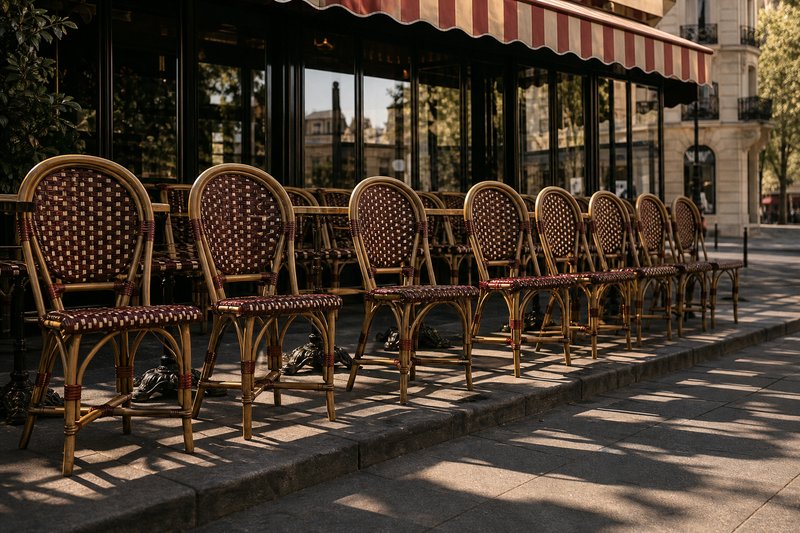
A Paris café terrace is a machine disguised as furniture. Every element, from the outward-facing chairs to the marble rounds barely big enough for two cups to the awning and the tariff, was engineered across a century and a half to produce one output: comfortable, unhurried spectatorship. Once you see the machine clearly, you never choose a terrace badly again.
The chairs face out for a reason
First-time visitors notice the arrangement immediately, because it looks staged: nobody faces each other. The classic terrace points every chair at the pavement, couples sitting side by side like an audience, because the audience is exactly what they are. The convention dates to the grand boulevard era, when the café’s true merchandise became the passing city itself.
It survives because it still works, every single day. Conversation happens comfortably at a forty-five degree angle, eye contact belongs to the street, and the whole geometry converts a sidewalk into a stage without a ticket booth. The chair itself, light and weatherproof and stackable in seconds, was purpose-built for the system, a story told in its own piece.
Sun geometry, or why corners rule
Terrace quality is mostly orientation, whatever the menu claims. South- and west-facing terraces own the afternoon, east-facing ones catch breakfast light, and corners beat straight rows by doubling the viewing angles while stretching the sun window across more hours. This is precisely why corner cafés became institutions in every quarter of the city.
The Café Charlot corner at Rue de Bretagne demonstrates the whole physics lesson in one address: its terrace wraps a south-west angle facing a market entrance, combining light and traffic, the two raw materials of the form, in a single seat. Shade has its July uses too, but the default Parisian scan reads sun lines, not menus.
The one-coffee treaty
The terrace’s social contract remains the most misunderstood deal in French hospitality. The espresso costs more out here than at the counter, positional pricing listed plainly on the board, and in exchange the table becomes yours indefinitely on a single order. No refill pressure, no bill until summoned, no hovering waiter working the turnover.
An hour per coffee is normal, and two raise no eyebrows anywhere. The ordering decoder covers the mechanics, but the spirit matters more: you are not a table to be turned, you are a tenant with a lease measured in cups. Very few hospitality systems anywhere sell time this honestly.
Honor the treaty in both directions, because it only works when both parties do. Order something each additional hour when the terrace is full, and never occupy prime seats through a lunch rush with one cold crème unless you enjoy being silently catalogued by professionals who have catalogued far worse than you.
The awning, the lamp, the blanket
Three pieces of equipment quietly extend the season to all twelve months. The awning is the underrated workhorse, making the terrace usable in rain and taming the low autumn sun, which is why serious corners invest in the full retractable article rather than fixed canvas. Heat lamps then turned winter sitting from endurance into habit.
The folded blanket on the chair back completes the kit, a Scandinavian import Paris adopted without ever admitting the borrowing. Blankets mark the cafés that actively want you outside in January rather than merely permitting the experiment. Between the three technologies, terrace season officially never closes, and the machine runs straight through the darkest weeks.
Terraces worth crossing town for
A short and opinionated list to finish the tour. Café Charlot for market-corner theatre in the Marais. Le Select on Boulevard du Montparnasse for the very last of the great wide-boulevard terraces still operating. Café de Flore’s corner for literary Saint-Germain, taken early before the queue forms, with the Flore profile explaining the exact timing.
Add the Place des Vosges arcades for the architecture-over-traffic trade, and one wildcard: any two-table pavement setup on a market street at 9:00, where the terrace is simply a café keeping an eye on its neighborhood. That is the form at its smallest and arguably its purest, and it asks only that you sit facing the right way.
Frequently Asked Questions
Why do Paris café chairs face the street?
Because the street is the show being sold. The outward-facing row turns every terrace into theatre seating, with couples sitting side by side like an audience at a matinee. The habit is usually credited to the boulevard culture of the nineteenth century, and no generation since has found any reason to abandon the arrangement.
Can you sit on a terrace with just one coffee?
Yes, and that single fact is the founding treaty of the terrace. The higher terrace price rents the chair itself; once served, the table is yours without refills, hints or hovering. Order a second cup when you actually want one, and honor the deal by not camping through a visible rush hour.
When is terrace season in Paris?
Officially it never ends, because heat lamps, awnings and folded blankets keep the chairs occupied straight through winter. The best conditions run April to June and again September to mid-October, when sun and temperature cooperate reliably. A January crème outdoors under a blanket is its own minor genre of Parisian morning, worth trying once.
Which direction should a good terrace face?
South or west for the afternoon light that terraces were built to harvest, east if your café hours run to breakfast. A terrace on a shaded northern pavement survives on foot traffic alone, fine for people-watching and useless for warmth. Parisians read sun lines down a street the way sailors read wind.
Are terrace prices higher?
Yes, deliberately and legally: French cafés price by position, and the terrace tier sits at the top of the two or three tariffs listed on the mandatory price board. You are renting outdoor real estate with a coffee attached. The premium funds the sitting rights that make the whole institution work as designed.
What is the best café terrace in the Marais?
For pure people-watching, the corner terrace of Café Charlot facing the Marché des Enfants Rouges has no serious local rival, with the market's entire choreography playing across the street. For architecture over traffic, the arcade tables on Place des Vosges trade the bustle for seventeenth-century symmetry, and win that trade every calm morning.