
Nobody is born knowing that “un café” means espresso, and the Paris café menu, frequently unwritten, runs on vocabulary that rewards the prepared. Five minutes here saves years of pointing at the next table’s cup. This is the whole system, from the core six drinks through the etiquette to the unspoken milk clock that organizes all of it.
The core six
Un café is the default: a single espresso, black, sugar on the saucer, finished in three sips or stretched across an hour, both entirely legitimate. Une noisette adds a dash of milk or a spoon of foam, named for its hazelnut color, and works as the insider’s order at any hour, barely milkier than black and never juvenile.
Un crème, properly un café crème, brings espresso with steamed milk and rules the morning as the standard milk drink; ask for un grand crème when breakfast depends on volume. Un allongé stretches the espresso with extra water through the machine, and its cousin un américain answers most filter-coffee homesickness at any classic counter.
The last two round out the family. Un déca is decaf, available everywhere and considerably better than its old reputation since the specialty wave forced standards upward across the board. Un café viennois crowns espresso or chocolate with whipped cream, more café-as-dessert than daily driver and gloriously unembarrassed about the fact. That covers ninety-five percent of every order.
Three orders that confuse everyone
A short appendix of edge cases, learned the awkward way. Un café serré is the tighter, shorter pull for people who find normal espresso dilute, and un café léger runs the other direction. Neither appears on any board, and both are understood everywhere, which is the general pattern with French café vocabulary: spoken tradition first, print later.
The water question has its own choreography. Ask for une carafe d’eau and tap water arrives free, without ceremony, as much as you want. Bottled water offered unprompted is a bill item and politely declinable. And une noisette contains no hazelnut whatsoever, a disappointment this decoder prefers you to meet here rather than at the counter.
The milk clock
One rule organizes everything else: milk belongs to the morning. Crèmes and cappuccino-adjacent drinks read as breakfast, the afternoon drinks black, and the after-dinner order is un café, full stop. No waiter will refuse a 16:00 crème, because this is commerce rather than law, but the room registers the order all the same.
The all-day loophole exists, and the locals use it themselves: the noisette. Barely milkier than black, acceptable at every hour, and invisible to the clock. The full logic behind the schedule, and why the café can charge three prices for one drink, is unpacked in the French coffee culture piece for the structurally curious.
Where you stand changes what you pay
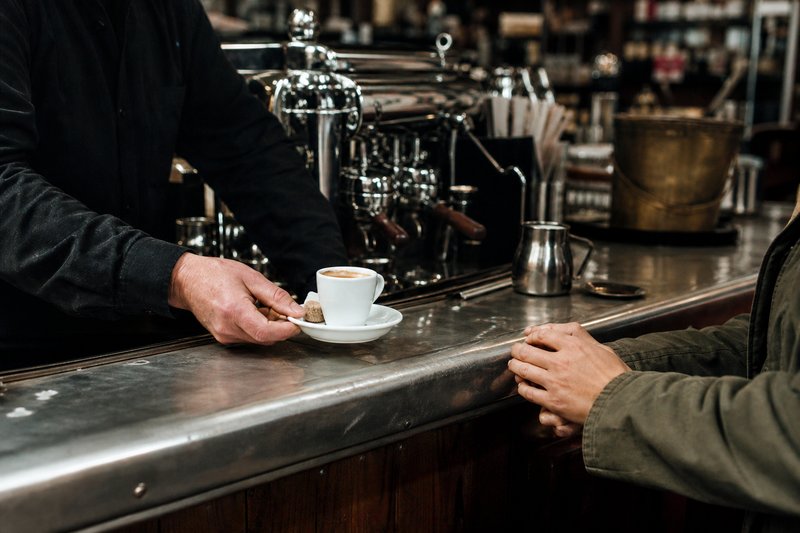
Before ordering anything, decide your position, because the price board lists two or three tiers: comptoir at the counter, salle at an indoor table, terrasse outside. The counter espresso is the famous bargain, often half the terrace price, drunk standing at the zinc among regulars who have occupied the same meter of bar for decades.
The terrace price buys the chair for as long as you want it, one order at a time, which is the entire terrace theatre in a single transaction. Pick by agenda rather than habit: ninety seconds of caffeine standing up, or an afternoon of streetwatching sitting down, with the tariff scaling honestly between them.
The etiquette in four gestures
Greet first, because “bonjour” before anything else is the actual password of French service, and its omission explains most stories about Parisian rudeness. Order without menu anxiety, since the vocabulary above is the menu. Signal for the bill when ready, with “l’addition, s’il vous plaît” or the universal air-scribble, because it never comes uninvited.
Then simply practice, which is the pleasant part. The corner at Café Charlot serves several hundred live demonstrations daily, and by the third visit “une noisette, s’il vous plaît” comes out on its own. That is the exact moment Paris cafés stop being a menu problem and start being a habit, which was the point all along.
Frequently Asked Questions
How do you order a normal coffee in Paris?
Say 'un café, s'il vous plaît' and an espresso arrives, because that is the normal coffee of France: small, black, sugar on the saucer. If you want something closer to a filter-sized black cup, ask for un café allongé or un américain instead, and the machine will stretch the shot accordingly without anyone blinking.
What is a noisette?
An espresso with a small dash of milk or a spoonful of foam, named for the hazelnut color the milk produces rather than for any hazelnut flavor. It is the connoisseur's compromise between black and milky, welcome at every hour of the day, and the single most useful word this decoder will teach you.
What is the difference between café crème and café au lait?
In a café, order un crème: espresso with steamed milk, the standard morning milk drink and the closest native relative of the cappuccino. Café au lait is essentially the same idea but belongs to the home breakfast bowl. Ordering it out simply gets you a crème anyway, delivered with a barely detectable flicker of amusement.
Can you order a cappuccino in Paris?
At the specialty coffee shops, absolutely, and the results are often excellent, since the new generation trained on exactly that drink. At classic brasseries you may instead receive an improvised crème dusted with cocoa powder, priced ambitiously. Order each house's strength, cappuccino at the counters and crème at the corners, and everyone stays happy.
Is it cheaper to drink at the counter?
Yes, meaningfully so: the counter price beats the terrace price for the identical drink, sometimes by half, and the price board by the till lists every tier by law. Standing espresso at the zinc remains the last great deal in Paris hospitality, which is precisely why the morning regulars have never abandoned the position.
Do you tip for coffee in Paris?
Service is included in every price by law, so nothing further is owed. Rounding up or leaving the small coins from your change is appreciated for table service and common among locals, but percentage tipping is not expected for a coffee anywhere. Leave the maths at home; the culture already did it for you.