
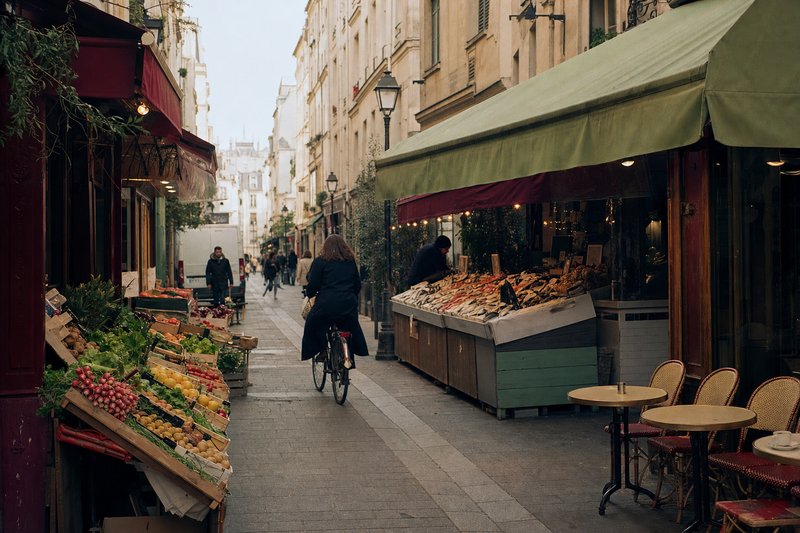
Every quarter of Paris has one street doing the actual work, and in the upper Marais that street is Rue de Bretagne. It is not the prettiest street in the 3rd arrondissement, and nowhere near the oldest, but it is where the neighborhood buys its cheese, argues about tomatoes, reads on terraces and meets at number 38.
This guide walks the street end to end, market to counters to café corners, and explains the rhythm that makes it worth far more than a drive-by photograph. Budget an hour on paper and expect to spend three, because that arithmetic error is the standard local experience and nobody has ever corrected it.
Walking Rue de Bretagne end to end
The street runs a compact east-west line through the 3rd, and fifteen unhurried minutes cover it on paper, though nobody has ever managed fifteen. Start at the eastern end near Filles du Calvaire and the shopfronts announce the program immediately: a fromagerie with its seasonal chalkboard, a fishmonger arranging ice, bakeries running their second batch.
Add a bookshop, a florist and produce grocers who still stack their crates by hand, and the inventory is complete. Rue de Bretagne kept its food-street DNA while the blocks around it converted to fashion retail, and that stubbornness is the entire appeal. Halfway along, the street hands you its centerpiece without ceremony.
The Marché des Enfants Rouges: the market at the heart
Behind an easy-to-miss gateway at number 39 sits the oldest covered market in Paris, trading continuously since 1615. The name, market of the red children, remembers the orphans of a nearby sixteenth-century hospice who wore red cloth as a mark of charity. The orphanage vanished centuries ago; the name never left the gate.
Inside, the Marché des Enfants Rouges runs a double life with total confidence. It is a genuine produce market, vegetables and cheese and flowers and an organic grocer, and simultaneously one of the best cheap-lunch halls in central Paris: Moroccan couscous, Japanese bento, Italian plates, Lebanese mezze, crêpes, all eaten at shared benches.
The market closes Mondays and runs at full song on Saturday and Sunday, when finding a bench after noon becomes a contact sport played with perfect politeness. Weekday mornings stay calm enough for conversation with the vendors, which is when the hall shows its working face rather than its performing one.
A strategy that works every time: arrive at 11:30, walk one full lap before committing to anything, because the lap is mandatory and everything smells better than the last thing, then order and carry your plate toward whichever bench is visibly finishing. Coffee afterward happens across the street rather than inside, by long-standing local convention.
The corner at number 38
Directly opposite the market entrance, Café Charlot occupies the corner of Rue Charlot at 38 Rue de Bretagne and functions as the street's living room, clock and observation deck at once. From its terrace the whole theatre plays out: crates wheeling in at dawn, the crowd swelling toward noon, the evening apéritif conversion.
Hours, menu and tactics live in the visiting guide, so one practical point suffices here: the corner table is the single best seat for understanding how this street actually works. And 38 Rue de Bretagne remains the meeting point every local suggests, because nobody in history has failed to find the corner café.
The Marais village around it
Step off the street and the Marais offers two immediate detours worth the steps. North sits the Carreau du Temple, the restored nineteenth-century iron market hall now hosting design fairs and fashion-week events, worth a look inside for the roof alone. Beside it, the Square du Temple garden supplies the benches the market lacks.
South and east, the boutique Marais takes over with galleries, vintage dealers and the specialty coffee generation: Boot Café's tiny blue shopfront, Partisan, and the design-planet interiors of Café Nuances, all mapped in the Marais café walk. Rue de Bretagne anchors all of it without belonging to any of it.
Getting there from central Paris
Three metro options bracket the street: Filles du Calvaire on line 8 at the eastern end, Temple on line 3 to the north-west, and Arts et Métiers on lines 3 and 11 to the south-west. From République the walk runs a flat ten minutes, passing enough bakeries to compromise most schedules before the street even begins.
Come hungry, come before noon when possible, and give the visit more time than the map suggests, because short streets with a 400-year-old market in the middle dissolve schedules professionally. The weekend version pairs naturally with the brunch circuit; the weekday version pairs with nothing at all, which is rather the point.
Frequently Asked Questions
Where is Rue de Bretagne in Paris?
In the 3rd arrondissement, running east to west through the upper Marais and carrying most of the quarter's daily food life. The closest metro stations are Filles du Calvaire on line 8, Temple on line 3 and Arts et Métiers on lines 3 and 11, with République itself a flat ten-minute walk from the eastern end.
What is Rue de Bretagne known for?
The Marché des Enfants Rouges above all, the oldest covered market in Paris trading since 1615, plus a dense run of food shops, bookstores and café terraces filling the street around it. Taken together they make it the closest thing the Marais has kept to a genuine village high street, and the locals treat it accordingly.
When is the Marché des Enfants Rouges open?
Tuesday through Sunday, from morning until early evening, with the cooked-food counters running their lunch rush from about 12:30 onward. The market rests on Mondays, and the street noticeably drops to half volume without it. Sunday morning brings the full-throttle version, with produce stalls, flower sellers and every bench contested well before noon.
Why is it called the market of the red children?
The name remembers the children of a sixteenth-century orphanage nearby, dressed in red cloth as a mark of charity, les enfants rouges. The orphanage itself vanished centuries ago, while the name simply stayed attached to the market that fed the neighborhood around it. Four hundred years later nobody has found a reason to change it.
What can you eat at the Marché des Enfants Rouges?
The produce, cheese and flower stalls share the hall with cooked-food counters covering remarkable ground: Moroccan tagines and couscous, Japanese bento, Italian plates, Lebanese mezze and French classics, most between ten and fifteen euros. Order at whichever counter convinces you, find a bench, and accept that indecision during the first lap is structurally part of the experience.
Which cafés are on Rue de Bretagne?
Café Charlot holds the famous corner at number 38, directly opposite the market entrance, and works as the street's de facto living room. Within a few minutes on foot the specialty generation takes over: Boot Café, Partisan and Café Nuances are all covered in our Marais café guide, each an easy detour off the main stretch.
Is Rue de Bretagne worth visiting on a first trip to Paris?
Yes, precisely because it was never built for visitors. An hour here shows how the Marais actually eats and shops, which no monument manages, and the rhythm of crates, dogs and double-parked deliveries is the genuine article. Combine it with the Carreau du Temple and the Square du Temple garden next door for a half-day.
What is the best day to visit?
Saturday delivers full market energy with slightly fewer tourists than Sunday brings, and Tuesday through Friday mornings give the calm version where the fromager has time to talk through the seasonal counter. Mondays the market closes and the street runs at half volume, still pleasant for shopfronts and terraces but missing its main event entirely.
Where is 38 Rue de Bretagne?
On the corner of Rue Charlot at the market end of the street, which makes it the easiest rendezvous in the quarter. It is the address of Café Charlot, whose wraparound terrace faces the market gateway directly. Everyone can find the corner café, which is exactly why locals name it as the default meeting point.
Is the street expensive?
Mixed, honestly, and worth understanding before you order. Market produce and counter lunches stay fair for central Paris, with cooked plates between ten and fifteen euros, while the boutiques trend upward the way the whole upper Marais has this decade. A market lunch plus a terrace coffee still lands under twenty euros, a genuine bargain locally.