
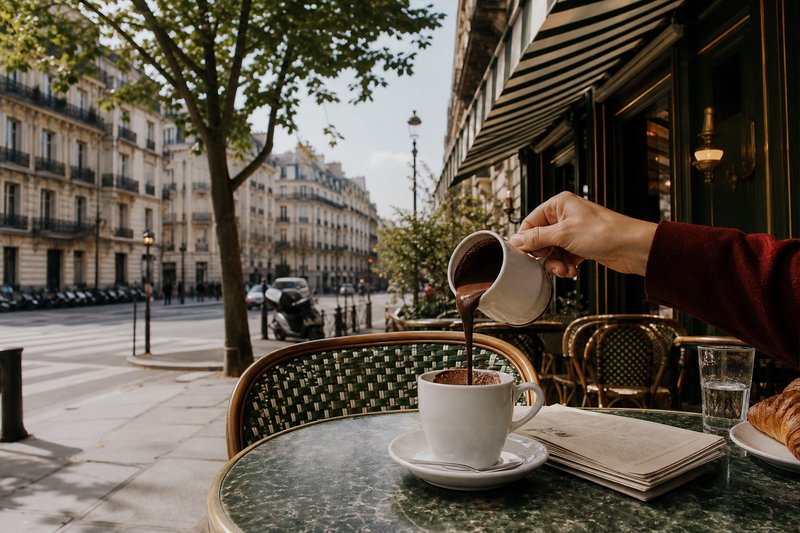
Every famous café accumulates a queue, a gift-shop instinct and a thousand identical photographs, and most hollow out under the weight. Café de Flore has all three and survives them, which is the actual miracle of the place: beneath the fame there is still a working café, arguably the last of the great literary rooms that genuinely functions as one.
The résumé, briefly
The Flore opened in the 1880s, named for a statue of the goddess across the boulevard, and spent its first decades as a respectable neighborhood café with literary tendencies. The tendencies won completely. Apollinaire ran an editorial office at its tables, and the interwar years brought everyone from Breton to Picasso through the door, sometimes nightly, usually unpaid.
During the Occupation, Sartre and Simone de Beauvoir famously worked the first floor like an office: warm, lit, supplied with coffee when their own flats were neither. “The road to Flore was the road to freedom,” runs the Sartre line the café will never let anyone forget, printed and reprinted wherever the house tells its own story.
Postwar, the fame institutionalized itself. The Prix de Flore, the literary prize founded in 1994 and judged over drinks upstairs, formalized what the tables had already been doing for a century. Through every cycle the physical café barely moved: green-and-white awning, red banquettes, brass rails, mirrors, the rattan rows outside. That continuity is now the product being sold.
What to actually order
One answer towers over the menu, and it is the chocolat chaud. It arrives as a small jug beside an empty cup; you pour, it coats, and for a few minutes the price of everything on the card makes sense. It is the best hot chocolate of the famous tier, Angelina’s thicker version notwithstanding, and it converts skeptics reliably.
The coffee is honest brasserie espresso, because as everywhere in the classic canon, the cup is not the point. Breakfast eggs are quietly good, the club sandwich remains the regulars’ lunch, and the prices sit at the top of the café spectrum. The only healthy way to read the bill is as heritage admission with calories attached.
Beating the room’s own fame
Timing is everything here, and the working rule fits in one line: weekday, before 10:00. The morning terrace still belongs to the quarter, meaning publishers, dogs and one philosopher-looking man doing crosswords, and the waiters have time to be charming. From 11:00 the tour-group tide arrives, the queue forms, and the café performs itself until evening.
Sit inside at least once, whatever the weather is doing. The terrace gets the photographs, but the banquette room is where the café’s actual temperament lives, and in winter it is simply the better café. Sunset recovers some magic indoors too, upstairs especially, where the Sartre-era tables hide from the cameras and the boulevard noise drops away.
The upstairs room
First-timers rarely find the staircase, which suits the initiated fine and keeps the room what it is. The first floor runs quieter and warmer than the boulevard level, holds the tables where the philosophy actually got written, and serves the same card with slightly more patience. Ask a waiter, or simply walk up; nobody stops you, and nobody ever has.
Flore in the wider canon
The comparison with Les Deux Magots, forty meters away, resolves best by refusing to choose: one drink at each, same morning, opinions for life. In the broader historic-café canon, Flore is the youngest of the great rooms and the most alive. Procope out-dates it by two centuries but became a restaurant; Flore still runs café hours and café rhythms.
It still seeds the form’s future, mostly without credit. Every design-conscious newcomer measuring itself against the classic Paris café, from the fashion-house cafés to the Marais’s new-wave counters, is quoting this corner whether it knows it or not. The awning is the reference. The rattan is the reference. The two-hour lease on one extraordinary hot chocolate: also the reference.
Bring cash for the admission and a book for the lease, and the most famous café in Paris will treat you exactly as it treated the century of regulars before you, which is the entire secret of the place. It will take your order, remember your face by the third visit, and otherwise leave you magnificently, professionally alone.
Frequently Asked Questions
Why is Café de Flore famous?
A century of literary residency did it: Apollinaire edited a review at these tables, Sartre and Beauvoir effectively kept office hours upstairs through the Occupation, and the postwar café became the salon of Saint-Germain. The room, the green awning and the rattan rows barely changed while the fame compounded around them, decade after decade.
What should you order at Café de Flore?
The chocolat chaud, served in a small jug and thick without turning to sludge, is the house masterpiece and the order that justifies the visit. The espresso is respectable brasserie standard, nothing more, and the breakfast eggs are the quiet sleeper pick. Nobody comes to the Flore for value; come for the one great specialty.
How expensive is Café de Flore?
Grand-café pricing applies in full: expect the hot chocolate and the coffees to cost several times what a corner café charges, with food priced to match the address. The premium buys the rattan, the mirrors and the most documented terrace in Saint-Germain. Decide it is admission rather than extortion and the bill reads very differently.
Café de Flore or Les Deux Magots?
They are neighbors, rivals and forty meters apart, so the comparison never dies. Flore keeps a slight edge in literary lore and interior warmth; Deux Magots wins on square-facing terrace geometry and morning light. The honest answer, practiced by generations of visitors, is one unhurried drink at each during the same morning, then a verdict.
When is the best time to go?
Weekdays before 10:00, when the terrace still belongs to regulars, service runs at its most human and the light is at its best. Midday and weekends bring queue-and-camera hours that show the room at its worst. Evenings recover some calm indoors, especially upstairs, where the famous first-floor tables hide from the boulevard entirely.
Where exactly is it?
At 172 Boulevard Saint-Germain, on the corner of Rue Saint-Benoît in the 6th arrondissement, with Saint-Germain-des-Prés as the nearest metro station. Les Deux Magots and the abbey church are immediate neighbors, which makes the block a compact pilgrimage: two legendary cafés, one Romanesque tower and a bookshop or two within a hundred meters.