
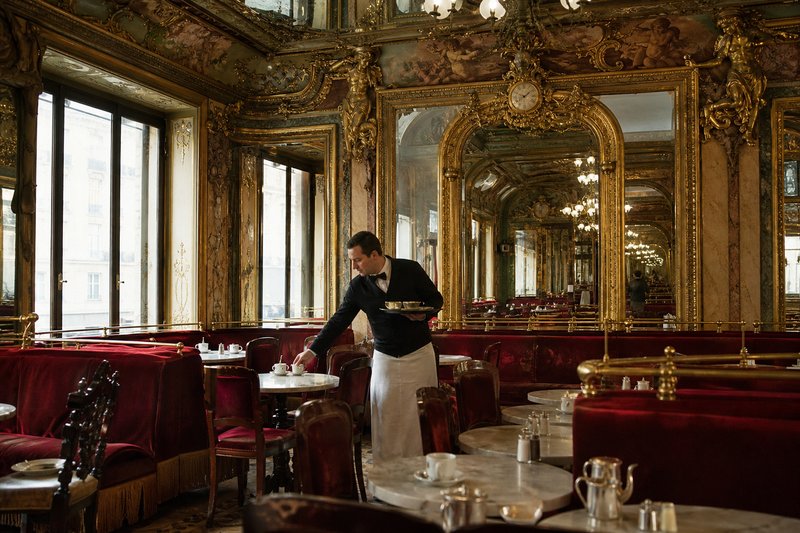
Paris does not preserve its old cafés behind glass; it keeps them open and lets you order, making oldest a working category here rather than a plaque. What actually survives inside each room varies enormously, from genuine seventeenth-century walls to skilled stagecraft, and telling the difference is half the pleasure. A field guide, oldest first.
Le Procope, 1686
The origin point still stands at 13 Rue de l’Ancienne Comédie, where the Sicilian Francesco Procopio dei Coltelli opened his café opposite the Comédie-Française’s home of the day and invented the template: coffee, conversation, marble, mirrors. Voltaire allegedly ran a forty-cup-a-day habit here, and the Encyclopédie was argued into shape at these tables.
Today Le Procope is a full restaurant in period dress rather than a café in any working sense, so visit accordingly. Come for the staircase, the Voltaire desk and the sensation of the address, keep expectations for the coffee ritual modest, and count the detour worthwhile anyway. Monuments that still take dinner reservations deserve a certain indulgence.
Café de la Paix, 1862
The Second Empire survives intact beside the opera house, where Café de la Paix kept its gilded ceilings and columned opulence through every fashion cycle since Garnier’s era. The room is listed as a historic monument, and an espresso under those painted ceilings remains the cheapest admission ticket into imperial Paris that money currently buys.
The terrace watches Place de l’Opéra perform its traffic, which has its charms, but inside beats outside here decisively. The ceiling is the destination, the columns are the supporting cast, and the coffee is frankly incidental to both. Order once, sit long, and look up more than feels natural; the room was engineered for exactly that gaze.
Café de Flore, 1880s
The youngest of the grand literary cafés is also the only one still working its original job. Flore’s fame is twentieth-century, built on Apollinaire’s editorial sessions and on Sartre and Beauvoir treating the first floor as a heated office through the Occupation, but the café itself dates to the 1880s and never stopped running café hours.
That living quality earns it a place on this list and a full profile of its own in the journal. Les Deux Magots, its neighbor and rival since the same decade, makes the block a two-stop pilgrimage best resolved by refusing to choose between them. One morning, two terraces, opinions guaranteed for life.
Angelina, 1903, and Le Select, 1923
Angelina is technically a salon de thé and admitted here without apology, because the Belle Époque interior on Rue de Rivoli has barely moved since Proust’s day. The house hot chocolate, L’Africain, poured thick from a jug with cream alongside, remains the most persuasive historic beverage in Paris. Beat the international queue with a weekday opening-time arrival.
Le Select carries the Montparnasse twenties forward with the least embalming of anyone. Of the four surviving giants of the quarter, alongside La Coupole, Le Dôme and La Rotonde, it kept the most café-soul: long terrace, old-school waiters, prices that never floated off with the tourist tide. The Lost Generation mythology feels least like mythology here.
The ones that did not make it
The survivor list reads differently once you know the casualties, which were the majority. The Café de la Régence, where chess ran as spectator sport for two centuries and Napoleon played badly, is gone entirely. The original Café Anglais closed in 1913, and the hundreds of cafés that packed the Palais-Royal arcades before the Revolution vanished without plaques.
Survival, in this trade, is itself the achievement being celebrated, and it was never guaranteed for any room on this page. That fragility is worth carrying into the visits: these are not permanent fixtures of the city but businesses that happened to outlast every rival, one served coffee at a time, across three centuries of competition.
How to use the old rooms
Three rules travel across the canon. Go early on weekdays, because every one of these cafés is at its best before 10:00 and worst at Saturday noon. Order the signature once and count the premium as heritage admission. And balance each pilgrimage with the living tradition, because the corner café serving its neighborhood today is the same institution, merely younger.
The old rooms are not exhibits of a dead form; they are the form, older, still pouring. For where the story goes next, the best-cafés guide picks up at the specialty wave of the 2010s, the chapter future historians will write about the way this journal writes about 1686. The café, on current evidence, does not retire.
Frequently Asked Questions
What is the oldest café in Paris?
Le Procope, opened in 1686 by Francesco Procopio dei Coltelli in Saint-Germain, holds the title and still operates at 13 Rue de l'Ancienne Comédie. Today it functions more as a restaurant in period dress than as a café, but the address, the staircase and the walls remain the genuine seventeenth-century article, plaque and all.
Did Voltaire really drink coffee at Le Procope?
Yes, prodigiously: Voltaire, Diderot, Rousseau and the Encyclopédie circle were documented regulars, and the house has dined out on the association ever since. A writing desk attributed to Voltaire forms part of the décor upstairs. Treat individual relics with a raised eyebrow and the broader history with respect; both attitudes are locally traditional.
Which historic Paris cafés are still worth visiting?
Café de la Paix for intact Second-Empire splendor under painted ceilings, Café de Flore for the last living literary café, Angelina for Belle Époque pastry theatre on Rue de Rivoli, and Le Select for the Montparnasse of the twenties at honest prices. Each survives as a working room rather than a museum piece, which is the point.
Are the historic cafés expensive?
Terrace espresso at the famous rooms runs several times the corner-café counter price, and the signature drinks climb from there. The workable strategy is ordering the house specialty once, at an off-peak hour, and accounting for it as museum admission with calories. Nobody has ever regretted the Flore chocolate on those terms.
What happened to the cafés of the Lost Generation?
Montparnasse keeps four of them alive within two blocks: Le Select, La Coupole, Le Dôme and La Rotonde, all still serving daily. Le Select has changed least in spirit, with a long boulevard terrace and old-school waiters; Hemingway's crowd would still recognize the room, and probably still argue about the bill.
When is the best time to visit a historic café?
Weekday mornings before 10:00, without exception across the whole canon. The rooms sit calm, the staff have time, and the light flatters interiors designed before electricity. Midday weekends deliver the queues, the cameras and the worst version of every famous room, a rule that has held for at least fifty years.