
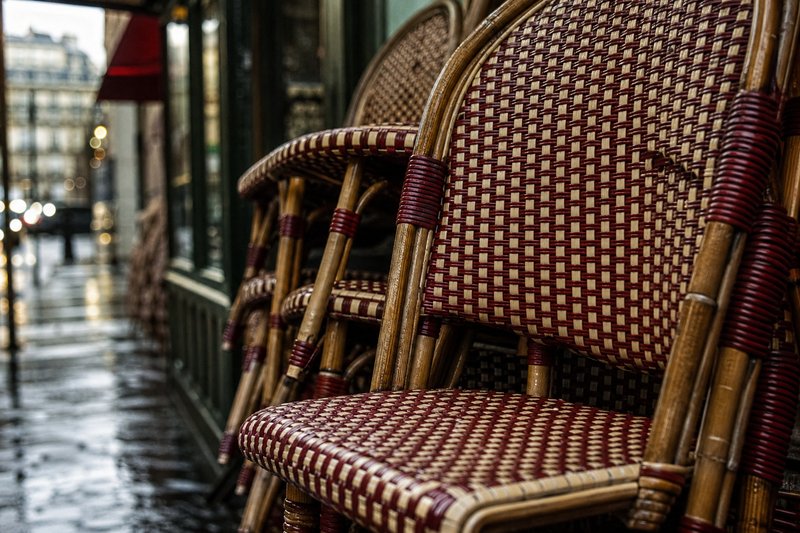
Sit outside anywhere in Paris and the odds are excellent that the chair beneath you was woven by hand in a French workshop that has been doing exactly this since before your grandparents were born. The rattan bistro chair is the most-photographed piece of furniture in Europe and somehow the least examined. It deserves five minutes of attention.
Born of the terrace boom
When boulevard café culture exploded in the late nineteenth century, terraces needed a chair that could live outdoors, move in armfuls and survive a thousand seatings a season without complaint. Maison Louis Drucker, founded in 1885, answered with the rattan-framed, hand-woven bistro chair, and Maison Gatti followed in 1920, turning the two-tone weave into a signature.
The design brief was pure logistics, light and stackable and weatherproof and repairable, and like most great French design the beauty arrived as a by-product of the constraints. A century later the same two houses still dominate the trade, still weave to order, and still supply the terraces their founders furnished, an industrial monopoly held by being right.
What the chair is actually made of
The frame is steam-bent rattan, the palm rather than bamboo, chosen for its strength-to-weight ratio and its willingness to hold a curve after steaming. The seat and back weave, originally natural cane, switched decades ago to Rilsan, a plant-derived synthetic fiber that shrugs off rain and sun, and the color palette exploded with the change.
Each chair is still woven by hand, junction-wrapped and finished over hours of work, which explains both the price of the genuine article and the existence of sagging plastic imposters on lesser terraces. Durability was the quiet victory: a good bistro chair survives decades outdoors and then gets re-woven rather than retired, furniture built on café economics.
That economic logic runs deep, because in this trade the chair is capital equipment. The seat is the actual product being rented, hour by hour, and equipment that lasts thirty years while stacking eight-high on one waiter’s arm beats anything cheaper that lasts three. Café owners buy chairs the way fleets buy tires, on arithmetic.
The weave as a signature
Somewhere along the way, the practical chair became a branding system nobody planned. The grand cafés commission their own colorways, and a specific weave now reads as instantly as an awning: regulars can identify their café from a photograph of a single armrest. The houses guard client patterns the way tailors guard cloth books.
That turns terrace-sitting into an accidental design safari for anyone paying attention. Two-tone diagonals here, tricolor bands there, a monogrammed motif on the ambitious corners, and once you start reading weaves you cannot stop. A walk through the Marais café circuit doubles as a furniture exhibition that none of the sitters ever notice attending.
Why imitations keep failing
The knockoff market has chased this chair for decades and keeps losing on physics rather than aesthetics. Molded plastic copies capture the look at a quarter of the price, then sag, fade and crack within a season or two of genuine terrace duty. The weight sits wrong for one-armed stacking, and repairs are impossible, so failure means landfill.
The originals cost more because hours of handwork live inside them, and they amortize across decades of daily abuse. Owners keep arriving at the same conclusion their predecessors reached in 1925, which is why the two old houses never lost the market. Some monopolies persist through patents; this one persists through being correct.
Spotting the real thing
Three checks work from your seat without tools. Edges first: hand-wrapped junctions where weave meets frame, no visible staples or glue lines anywhere. Tension second: a real weave sits drum-tight after years, while extruded plastic sags within months. Provenance last: many originals carry a maker’s plaque under the seat, the terrace equivalent of flipping porcelain.
None of this changes how the coffee tastes, admittedly. But the next time a waiter at a market-corner terrace stacks eight chairs on one arm at closing time, the exact maneuver the design was born for in 1885, you will know you watched the oldest piece of French café machinery still doing its job perfectly. The chair earned the postcard.
Frequently Asked Questions
Who makes the classic Paris café chairs?
Two historic French houses dominate the trade: Maison Louis Drucker, founded in 1885, and Maison Gatti, founded in 1920, both still weaving bistro chairs largely by hand for cafés worldwide. If you have sat outside a famous Paris terrace, the odds are excellent the frame beneath you came from one of those two workshops.
What are the chairs actually made of?
A steam-bent rattan frame, light, strong and weather-tolerant, woven with strips of Rilsan, a plant-derived synthetic fiber that replaced natural cane decades ago for outdoor durability. The synthetic weave takes color reliably, which is what opened the door to the signature two-tone patterns the great cafés now commission as identity.
Why do cafés use rattan chairs outside?
Terrace logistics built the design brief: the chairs weigh little enough for a waiter to stack thirty in minutes, shrug off weather for decades, repair by re-weaving rather than replacement, and signal café from a hundred meters. The form followed the morning setup routine, and the beauty arrived afterward as a by-product.
Can you buy authentic bistro chairs?
Yes: both Drucker and Gatti sell to private customers, with made-to-order weaves and prices that reflect handwork measured in hours per chair. Vintage examples circulate steadily through French flea markets and design dealers. A real one amortizes over decades of daily outdoor abuse, which is the honest defense of the price.
How can you spot a quality chair on a terrace?
Check the weave's edges and the frame junctions: hand-finished wrapping where weave meets rattan, tight uniform tension across the seat, and often a maker's plaque underneath. Sagging plastic lookalikes announce themselves within a single season of real service, while a Drucker or Gatti sits drum-tight through years of weather and stacking.
Does every café have its own pattern?
The grand cafés frequently commission signature colorways, and a recognizable weave has become part of a café's identity, as distinctive as the awning above it. Pattern libraries at the two houses run to hundreds of combinations, guarded like tailors' cloth books. Reading weaves off passing terraces is a legitimate Parisian spectator sport.