
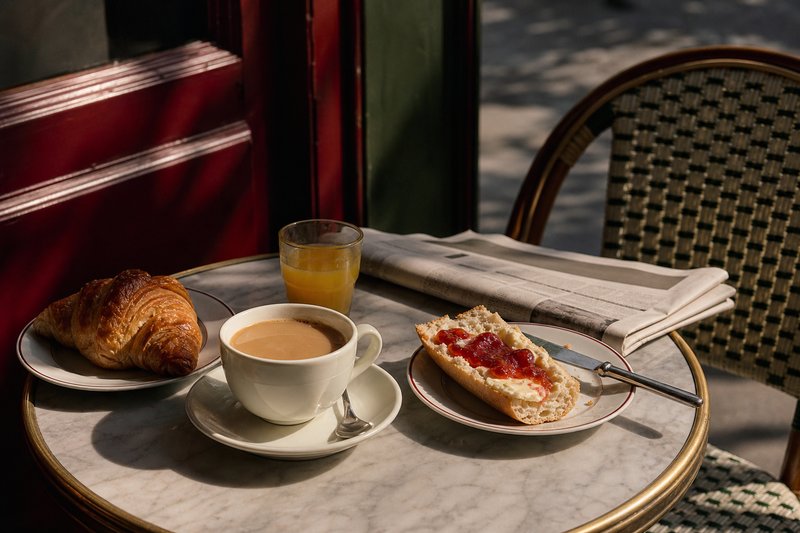
Somewhere in the last decade, breakfast in Paris got complicated. Avocado arrived, flat whites followed, queues formed outside rooms with twenty seats, and the brunch scene earned its place honestly. But the old formula never went anywhere, and on most mornings the petit déjeuner remains the best-value, best-located, least-queued breakfast in the city.
The formula
A proper café petit déjeuner is four things and rarely more: coffee, a tartine of half a baguette split lengthwise with salted butter and jam on the side, usually a croissant, and orange juice pressed somewhere within earshot. The whole tray lands in under five minutes because nothing on it needs a kitchen, and that speed is the design.
French breakfast works as an accompaniment to the morning rather than the event itself, which is the philosophical difference from brunch in one line. The price tells the same story: a full formule runs eight to fifteen euros almost everywhere, with the Café Charlot version sitting mid-range for the Marais, and the standing counter version still slips under five.
Try assembling any brunch plate in this city for that money and the comparison ends immediately. The formula’s quiet superpower is time: nobody flips your table, because the table was never the product being sold. Two hours, one newspaper and a second crème constitute a completely normal transaction under the old system, and always have.
How to order it properly
Three small codes separate the practiced from the tourists, and all three cost nothing. First, the coffee: morning means café crème or a noisette, not the mythical café au lait, which Parisians mostly drink from bowls at home. Second, the butter: beurre salé if offered, always, because an unsalted tartine is a rehearsal rather than a performance.
Third, the timing, which is looser than the guides pretend. The formula serves all morning, but the café changes tribes by the hour: before 9:00 you breakfast with the neighborhood, after 10:00 with travelers and freelancers stretching a crème into a lease. There is no fourth rule. It is breakfast, not an examination, and the room grades gently.
The viennoiserie hierarchy
Since the croissant carries the judging duty, know its family before ruling. The croissant au beurre, straight and all butter, is the reference article; the curved croissant ordinaire signals margarine and can be skipped without guilt. The pain au chocolat answers the chocolate question, and the chausson aux pommes handles the apple constituency honorably.
The pain aux raisins divides households like politics and always has. A café stocking the full family before 8:00, from a bakery it will name when asked, is signalling seriousness about the entire morning trade. One piece per person at the table is the custom; the second piece is what the walk home was invented for.
Judging a café by its breakfast
The petit déjeuner doubles as the cheapest diagnostic tool in Paris, three tests for the price of one meal. The croissant tests the bakery relationship, and its lamination should shatter audibly. The tartine tests the house itself: baguette from this morning, butter that saw a cow, jam from a jar rather than a blister pack.
The orange juice tests plain honesty, because pressée means pressed and a carton announces itself from across the room. A café passing all three at 8:30 will almost never disappoint at any other hour, and one failing them has told you something useful for the price of a breakfast. Few investments in Paris return information that cheaply.
Where the formula shines
Anywhere, in principle, which is the beauty of the thing. But it shines brightest where the morning has something to watch: a market corner like Rue de Bretagne as the stalls wheel in, a square with school traffic, a terrace catching first sun. Add the newspaper rack if the café still keeps one, and the machine is complete.
The petit déjeuner was engineered over a century for exactly this, twenty minutes of bread, butter, caffeine and street, and no quantity of ricotta toast has improved the core mechanics. The brunch guide argues the weekend counter-case fairly. On a random Wednesday, the correct answer remains the nearest good café, the formula, a table facing out.
Frequently Asked Questions
What is a typical petit déjeuner in Paris?
Coffee, usually a café crème in the morning, with a tartine of split baguette spread with salted butter and jam, often a croissant alongside, and fresh-pressed orange juice. Eggs remain an optional extra at cafés rather than the default. The whole formula arrives in minutes because nothing on the tray requires a kitchen.
How much does breakfast cost at a Paris café?
The set formule at a corner café runs roughly eight to fifteen euros depending on the neighborhood and whether juice is included in the price. Standing at the counter with an espresso and a croissant can still stay under five euros, which remains one of the most reliable food bargains central Paris has left.
What time do Parisians eat breakfast?
Early and fast, mostly: the counter crowd passes through between 7:00 and 9:00, one espresso standing at the zinc. Cafés serve the formula all morning regardless, and nobody anywhere blinks at a 10:30 tartine. The later hours simply shift the company from neighbors on schedules to travelers and freelancers stretching the table.
Is a croissant a normal daily breakfast in France?
Less than the postcards suggest, honestly. The daily default at home is tartine and coffee, while the croissant works as a café treat or a weekend ritual rather than a staple. That occasional status is exactly why judging a café by its croissant works so well: the bakery relationship shows immediately in the lamination.
What should you order for coffee at breakfast?
Café crème or a noisette, depending on how much milk the morning requires. The big milky café au lait bowl belongs mostly to home kitchens, and ordering the crème instead quietly marks you as someone who has done this before. The counter and terrace price difference applies at breakfast like every other hour.
Tartine or croissant: which is the better test of a café?
The croissant tests the bakery the café buys from, since lamination should shatter rather than bend. The tartine tests the house itself: the freshness of the baguette, the reality of the butter, whether the jam arrives in a jar or a sad plastic blister. Order both once and you know everything worth knowing.