
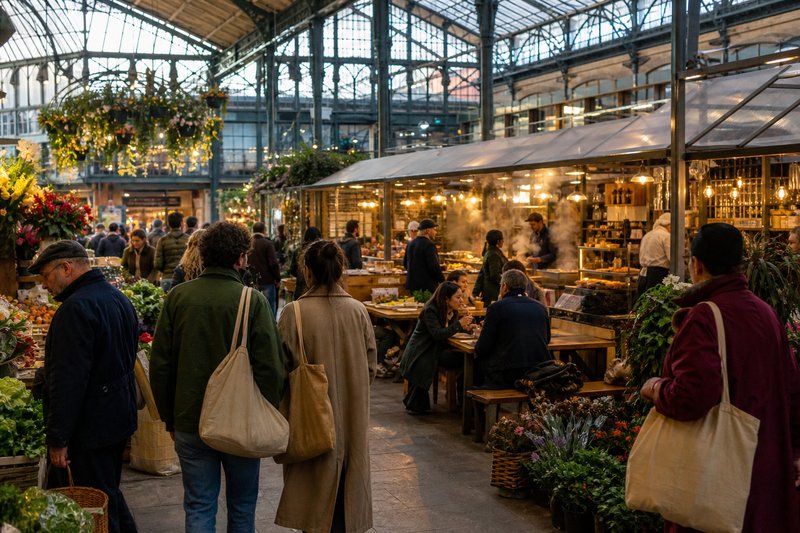
Blink at the wrong moment on Rue de Bretagne and you miss the gateway: a modest iron arch at number 39, easy to mistake for a courtyard entrance. Through it sits the oldest covered market in Paris, trading on this exact spot since 1615 and still doing both jobs it was built for, feeding the quarter and hosting its arguments.
Four centuries in three sentences
The market took its name from the children of a nearby hospice founded under François I, dressed in red as a mark of charity, les enfants rouges. The orphanage closed in the seventeenth century, while the market kept the name and simply continued trading through revolutions, through Haussmann’s demolitions all around it, and through everything the twentieth century attempted.
The closest call came in the 1990s, when a serious demolition attempt nearly ended the whole story in favor of development. Locals fought the project for years and won; the market reopened after renovation in 2000. That rescue explains the fierce sense of ownership still detectable at the benches, where regulars treat the hall as jointly held property.
The two markets inside one roof
Understand the hall as two businesses sharing an address, running on different clocks. The first is a working produce market: vegetables stacked by hand, a cheese counter with seasonal opinions, flowers, an organic grocer. This half peaks early, its serious shoppers working the stalls with canvas trolleys before 10:30 and vanishing before the second business wakes.
The second business is lunch, and it made the market famous far beyond the quarter. Around the edges run cooked-food counters that turned the hall into one of the best informal lunch rooms in Paris: Moroccan tagines and mountainous couscous, Japanese bento assembled to order, Italian antipasti, Lebanese mezze, crêpes for the undecided. Committee indecision dies here instantly.
Everything is ordered at the counter and eaten at shared benches under the old iron roof, four continents on one table when a group splits up sensibly. The queue at each counter is the menu review; read the lines, not the signs. Prices hold between ten and fifteen euros, which buys more honesty than most sit-down menus in the arrondissement.
Timing is the whole game
Weekday mornings show the market at its most honest, all restocking vendors and first-name regulars and room to examine everything twice. Saturday runs at full local volume without quite tipping over. Sunday is the spectacle: the entire Marais funnels through the gateway between 11:00 and 14:00, and the benches become contested territory managed by glance.
The professional move never changes. Arrive at 11:30, walk one complete lap without buying anything, which is harder than it sounds since everything smells better than the thing before, then commit and time your bench approach to a table that is visibly finishing. Eating in two shifts is normal, and sharing with strangers is structurally required.
One Monday warning, learned eventually by every visitor: the market rests that day, and Rue de Bretagne runs at half volume without its engine. Plan the week’s market visit for any other morning, and if Monday is all you have, the street’s shops and corner terraces still reward the walk, just without the main event behind the arch.
What to buy besides lunch
The produce half deserves your euros as much as the counters do, and buying one real grocery item changes your status from spectator to customer. The cheese stall cuts to order and vacuum-packs for travelers without being asked twice. The flower seller assembles modest bunches that survive a full day of walking, and the organic grocer stocks picnic ingredients.
The Square du Temple lawn two minutes north was practically designed for that picnic, a point worth remembering when every bench inside is taken. Vendors register repeat faces quickly here, and the second visit already earns a nod. By the third, the cheese counter remembers what you bought, which is the market’s oldest loyalty program.
After the plates
The correct final move is caffeine across the street, where the corner terrace at Café Charlot faces the gateway directly and has watched this exact lunchtime tide for decades. From that seat, with a crème, you can watch the next wave of first-timers walk past the arch, double back, and find it: the running joke, still funny.
For the street around the market, the Rue de Bretagne guide walks the whole stretch shop by shop, and the wider quarter’s coffee is mapped in the cafés of Le Marais. Both begin, as everything in this corner of Paris begins, within sight of the iron arch at number 39.
Frequently Asked Questions
When is the Marché des Enfants Rouges open?
Tuesday through Sunday, from morning until early evening, with the market resting on Mondays as it has for generations. The cooked-food counters hit their peak queue between 12:30 and 14:00 on weekends, when the entire Marais seems to arrive at once. Weekday mornings run calm enough that vendors have time for conversation.
Why is it called the market of the red children?
The name remembers a sixteenth-century orphanage nearby whose children were dressed in red cloth as a mark of charity, les enfants rouges. The orphanage itself disappeared in the seventeenth century, but the name attached itself to the market that fed the neighborhood and has now outlived its source by roughly four hundred years.
Is the market expensive?
The cooked-food plates rank among the better lunch deals in central Paris, with most landing between ten and fifteen euros for genuinely generous portions. Produce prices run standard for the Marais postcode: fair for the quality on the crates, without pretending to be a bargain basement. One market lunch beats most bistro menus nearby.
Can you sit down inside?
Shared benches and a scatter of tables serve the whole hall, all strictly first-come. On a Sunday after noon, seating becomes the market's scarcest commodity and a contact sport played with Parisian politeness. Order your food first, then hover with visible intent near a table that looks close to finishing; the system works.
What is the best stall for a first visit?
An unfair question with a reliable answer: walk one complete lap before ordering anything, because the hall rewards comparison shopping. The Moroccan counter's tagines and the Japanese bento boxes hold the longest steady queues, and in market logic the persistent queue is the only restaurant review that has ever meant anything.
How do you find the entrance?
The main gateway hides at 39 Rue de Bretagne, a modest iron arch almost directly opposite Café Charlot's corner terrace, with a second entrance around on Rue Charlot. Most first-timers walk past both at least once, which the neighborhood treats as a running joke now entering its fifth century of reliable performance.